
Difficult-to-Inspect Product Evaluation and Supplemental Visible Particulate Testing
Quality Supplemental Visible Particulate Testing for Difficult-to-Inspect Products Using Membrane Microscopy. Supporting USP <1790> and your batch release decision.
Turbid, colored, viscous, opaque, lyophilized, or otherwise Difficult-to-Inspect products limit how well 100% visual inspection can detect visible particles. USP <1790> requires supplemental testing to close that gap, and for many companies, that supplemental test is the single result standing between a batch and its release decision. We perform this testing with the same contamination-controlled, forensic-level sample handling we bring to every particulate investigation.

When 100% Visual Inspection Isn't Enough
Some products and containers make it difficult for an inspector to reliably see a particle, no matter how well the inspection process is designed. USP <1790> identifies these as difficult-to-inspect products and calls for supplemental testing when:
When is this package necessary?
- The solution is opaque or deeply colored
- The product is a lyophilized cake or powder
- The formulation is a concentrated suspension, emulsion, or ointment
- The container is translucent or opaque plasti
- The container is a blow-fill-seal or flexible bag
- The product is packaged in a foil, cartridge, or combination product configuration
In these cases, 100% inspection alone can’t give you the assurance USP <790> is built around. Supplemental testing closes that gap.
What Does Difficult-to-Inspect (DIP) Testing Package Include?
This isn’t visual inspection or a subvisible particle count. It’s a modified version of the USP <788> Method 2 Microscopic Particle Count Test — sometimes called membrane microscopy or modified membrane microscopy — adapted to count visible particles, not subvisible ones.
We pool a defined number of units, typically 20 or 80 depending on your lot size and AQL statistical sampling plan, into a single composite sample. That composite is filtered through a membrane, and every particle retained on the membrane is examined under the microscope. The membrane can capture material across a range of sizes, but for this test, we size and count against the visible threshold your accept and reject criteria are built around.
Looking for Clarity on Product-Quality Decisions?
Ensure drug product and medical device safety through our pharmaceutical forensics approach to evidence, study design, interpretation, and decision support for pharmaceutical and medical device companies across the globe.
Why this test carries so much weight
The math is unforgiving. Whether you pool 20 units or 80, you’re looking at one composite result, and your lot’s disposition depends on it. Miss a particle during sample prep, and you risk releasing product that shouldn’t go out. Introduce a stray fiber or contaminant during filtration, and you risk triggering an investigation or a rejection over something that was never actually in the product.
And because this is a destructive, pooled test, there’s rarely a simple do-over. If additional testing becomes necessary, USP <1790> requires the original and additional results to be combined, not restarted, so the quality of that first composite sample matters enormously.
That’s exactly why many companies hesitate to run this test in-house, and why they’re just as cautious handing it to an outside lab. A mishandled sample doesn’t just cost time. It can put your release decision on shaky ground.
Standards and Regulatory Context
This approach is described in USP <1790> as an alternate inspection strategy for supplemental testing of Difficult-to-Inspect products, and it draws on the membrane filtration method outlined in USP <788>, Method 2. The sample sizes involved, typically 20 or 80 units, follow the sampling schemes referenced in USP <1790> and are tied to your lot size and inspection level.
Applicability still needs to be determined for your specific product and program. This test supports the visual inspection strategy required under USP <790>, and it doesn’t replace your responsibility for establishing that strategy or making the release decision.
Morphology Metrics
- Forensic-ready particle imagery & sizing
- Automated morphology categorizations
- Direct connection to USP data logs
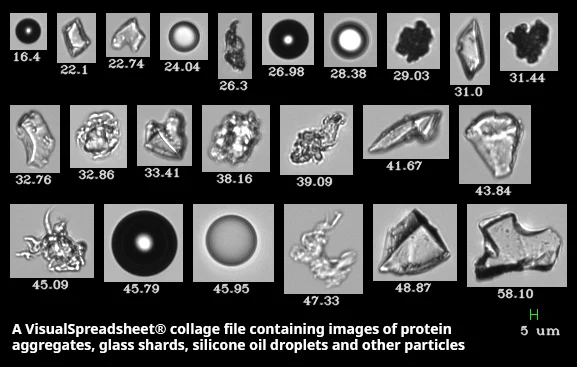
Built for this level of precision
Gateway’s foundation is in forensic particulate work — recovering, isolating, and characterizing minute amounts of material without introducing contamination or losing what we’re looking for. Pooling and filtering a composite sample for supplemental visible particulate testing calls for that same care:
- Contamination-controlled sample preparation for pooled, composite units
- Careful tracking of every unit through a destructive test sequence
- Clear reporting tied directly to your accept and reject criteria
- Microscopic sizing and counting against the visible particle threshold
Discuss Your Difficult-to-Inspect Product
Tell us about your formulation, container, sampling plan, and the release decision this test needs to support. We’ll walk you through how we handle the composite sample, and what you can expect in the report.

- cGMP Compliant & FDA, EMA, DEA Registered Laboratory Facility
- Specialized in Particulate Identification & Material Characterization

Gateway Analytical applies pharmaceutical forensics, specialized analytical testing, and expert interpretation to help regulated life science companies understand particulate, package integrity, subvisible particle, and component performance challenges. Contact our team to discuss your next product.
Particulate Risk Investigation and Root-Cause Resolution
Container Closure and Product-Package Integrity
- Cryogenic Packaging & Transport Simulation Studies
- Vacuum Decay Studies
- MicroCurrent High Voltage Leak Detection (HVLD)
- Laser-Based Gas Headspace Analysis
- Vials, Syringes, Cartridges, & Difficult Configurations
- Custom Method Development and Validation Across Multiple Platforms
- “Which CCIT Method Fits My Package?” use-case page
Visible & Subvisible Particle Characterization: Beyond Compendial Counts
Parenteral Packaging Functional Suitability
Biologics & Protein Therapeutics
Flow Imaging Microscopy (FIM/MFI) and orthogonal testing to instantly separate protein aggregates from silicone oil and foreign debris. By tracking particle morphology across formulation and packaging changes, we give you the technical clarity to de-risk development and satisfy regulatory scrutiny.
Sterile Injectables & Parenteral Manufacturers
Gateway delivers rapid, definitive particulate identification, complaint investigation support, and root-cause resolution alongside cGMP USP particulate testing to keep your operations moving. Paired with deterministic Container Closure Integrity Testing (CCIT) and USP <382> functional suitability evaluations.
Advanced Therapies (Cell & Gene Therapy)
Gateway specializes in low-volume particulate investigations, single-use component evaluations, and cryogenic container performance studies tailored to this evolving regulatory landscape.
Solving Drug Product Risks with Gateway Analytical. Applying Lifecycle Quality Risk Intelligence.
At Gateway Analytical, we apply Lifecycle Quality Risk Intelligence to connect analytical evidence across your entire product journey—combining rapid root-cause particulate identification, deterministic container closure integrity, subvisible particle characterization, and functional suitability testing.
By translating isolated laboratory data into long-term product understanding, we give your quality, operations, and regulatory teams the technical clarity and scientific proof needed to mitigate risk, resolve deviations, and release product with total confidence.
Technical Documentation & Resources
Connecting Analytical Evidence Across Your Drug Product Journey
By bridging our four core service areas: Particulate Investigations, Container Closure Integrity, Subvisible Characterization, and Functional Suitability—we transform routine laboratory data into deep product understanding, investigation readiness, defect prevention, and total regulatory confidence.
